
 Coaching Centre · Kaloor

Co-operative Bank
CSEB Junior Clerk, Assistant Secretary and other co-op bank posts.
Co-operative Bank CoachingKerala Bank, the Kerala State Co-operative Bank, recruits Clerk/Cashier, Office Attendant and other staff through Kerala PSC. Edupath prepares you for the co-operation, banking and IT portions of the exam in our classroom opposite Kaloor bus stand.
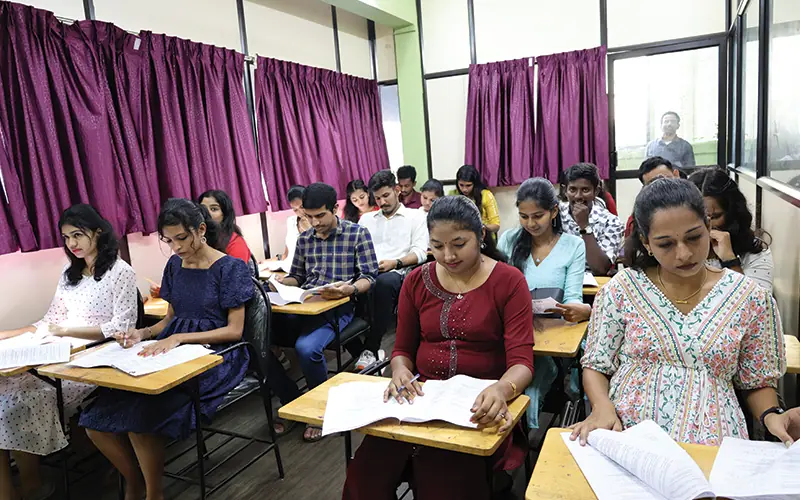
Kerala Bank is the brand name of the Kerala State Co-operative Bank, formed by merging the State Co-operative Bank with the district co-operative banks. It is the apex bank of Kerala's co-operative credit structure, with branches across the state.
Appointments to Kerala Bank are made through the Kerala Public Service Commission. Kerala PSC publishes a notification for each post, holds an objective-type (OMR or online) written test and prepares a ranked list. Selection is by direct recruitment.
Kerala Bank exams are separate from the co-operative bank exams of the CSEB, which fill posts in district and primary co-operative banks and societies. The subjects overlap, so see our Co-operative Bank Coaching page too. For IBPS and SBI exams, see Bank Exams Coaching.
Kerala PSC notifies Kerala Bank posts in two streams. The General Category is open to all eligible candidates. The Society Category is for eligible employees of member co-operative societies; vacancies are shared between the two streams. The ranked list is valid for at least one year and at most three years.
| Post | Educational qualification |
|---|---|
| Clerk/Cashier | A degree in Commerce, or a Master's degree in Arts with Co-operation as a special subject; or any bachelor's degree with the Higher Diploma in Co-operation (HDC, or HDC & BM of the State Co-operative Union of Kerala, or HDC and HDCM of the National Council for Co-operative Training) or the Junior Diploma in Co-operation; or a B.Sc. (Co-operation and Banking) from Kerala Agricultural University. |
| Office Attendant | A pass in Standard VII, and no degree. |
| Assistant Manager | A degree with at least 60% marks, plus the other conditions in the notification. |
Age limits, relaxations and the exact conditions for the Society Category are set in each notification. Read it on keralapsc.gov.in before you apply.
Points to remember. Keep every document the eligibility rules ask for. Mark cards and student licences are not accepted as ID. Your signature must be identical on all documents.
The Clerk/Cashier paper has three parts: Co-operation (50 marks), Banking (40 marks) and IT & Cyber Laws (10 marks).
| # | Topic | Details | Marks |
|---|---|---|---|
| 1 | Co-operation and other economic systems | Capitalism, socialism and communism; co-operatives and other forms of business organisation; how a co-operative differs from a partnership or joint stock company; the co-operative as an institution and an enterprise; the co-operative commonwealth | 5 |
| 2 | Evolution of co-operative principles | Rochdale pioneers; principles reformulated by the ICA; Karve Committee on co-operative principles; ICA principles of 1995; co-operative values versus co-operative principles | 5 |
| 3 | Types of co-operatives in India and Kerala | Short and medium-term credit structure; primary agricultural credit societies; urban and state co-operative banks; long-term credit (PCARDBs, SCARDBs); marketing societies and federations including NAFED; rubber, dairy, fishery, processing, housing, consumer, industrial and workers' co-operatives | 7 |
| 4 | Major co-operative organisations and supporting institutions | NAFED, IFFCO, KRIBCO, NABARD, NDDB, NCDC, National Housing Bank and other national bodies that assist housing co-operatives | 5 |
| 5 | Co-operative audit | Definition, objectives and scope; special features; administrative set-up; types of audit and the audit programme; stages of audit and final statements; reconciliation of bank accounts; the auditor's duties, powers and liabilities; audit report, certificate and classification; audit fees | 6 |
| 6 | Issues in co-operative management | Managing the social process; the associative character of a co-operative; small versus large area, single versus multipurpose, unitary versus federal co-operatives; financing a co-operative; evaluating a co-operative on its member, enterprise and ethical dimensions | 6 |
| 7 | Settlement of disputes | Arbitration and awards; execution of awards; appeals, review and revision; the co-operative tribunal; offences and penalties | 5 |
| 8 | Sources of funds | State aid, share capital contribution, principal and subsidiary state partnership funds, grants, subsidies, owned and borrowed funds | 5 |
| 9 | Co-operative legislation in India and Kerala | The 1904 and 1912 Acts; co-operation as a provincial subject; the NDC resolution of 1956; the Model Co-operative Societies Bills of 1957 and 1991; parallel co-operative laws; the Multi State Co-operative Societies Acts of 1984 and 2002; the Kerala Co-operative Societies Act 1969 | 6 |
Part II starts with commercial banking: the origin of the word "bank"; unit, branch, correspondent, group, chain and mixed banking; the functions of a commercial bank; types of deposits (savings, current, fixed, recurring, BSBDA, CASA) and certificates of deposit; lending methods (direct loans, cash credit, overdraft, discounting of bills); agency and general utility services; principles of lending; and credit creation. Read the full Part II topic list in the current Kerala PSC syllabus.
| # | Topic | Details |
|---|---|---|
| 1 | Hardware | Input and output devices (names, uses, features); primary and secondary memory |
| 2 | Software | System and application software; operating systems; word processors, spreadsheets, databases, presentation and image editors; basics of programming |
| 3 | Computer networks | LAN, WAN, MAN; network devices such as switch, hub, router, bridge and gateway |
| 4 | Internet | WWW, e-mail and search engines; social media; browsers and basic HTML |
| 5 | Cyber crimes and cyber laws | Types of cyber crime and the IT Act (awareness level) |
The Office Attendant post is open to candidates who have passed Standard VII and do not hold a degree. The paper follows a Kerala PSC general-knowledge pattern: general knowledge and current affairs, Kerala-specific topics, simple arithmetic and mental ability, and general science. Kerala PSC publishes the detailed syllabus with each notification, and we teach to that syllabus.
Class timings. Regular batch 10:00 AM – 1:00 PM. Evening batch 6:30 PM – 8:30 PM. Sunday batch 10:00 AM – 4:30 PM. Which batch runs for Kerala Bank depends on the notification, so ask on WhatsApp before you join.
Recruitment to Kerala Bank (the Kerala State Co-operative Bank) for posts such as Clerk/Cashier and Office Attendant is done through the Kerala Public Service Commission. You apply through your Thulasi profile on the Kerala PSC website when a notification is published.
No. Kerala Bank posts are filled through Kerala PSC. Posts in district and primary co-operative banks and societies are filled through the Kerala State Co-operative Service Examination Board (CSEB). The co-operation and banking topics overlap, so one preparation helps with both. See Co-operative Bank Coaching.
Kerala PSC notifies Kerala Bank posts in two streams: the General Category, open to eligible candidates, and the Society Category, for eligible employees of member co-operative societies. Each stream has its own rules in the notification.
Edupath runs a regular batch from 10:00 AM to 1:00 PM, an evening batch from 6:30 PM to 8:30 PM and a Sunday batch from 10:00 AM to 4:30 PM. Which batch runs for Kerala Bank depends on the notification, so WhatsApp us before you join.
Each course has its own page with the pattern, syllabus and how to join.
CSEB Junior Clerk, Assistant Secretary and other co-op bank posts.
Co-operative Bank Coaching
Tell us which exam you're preparing for and when you can attend. Or skip the form and message us on WhatsApp.