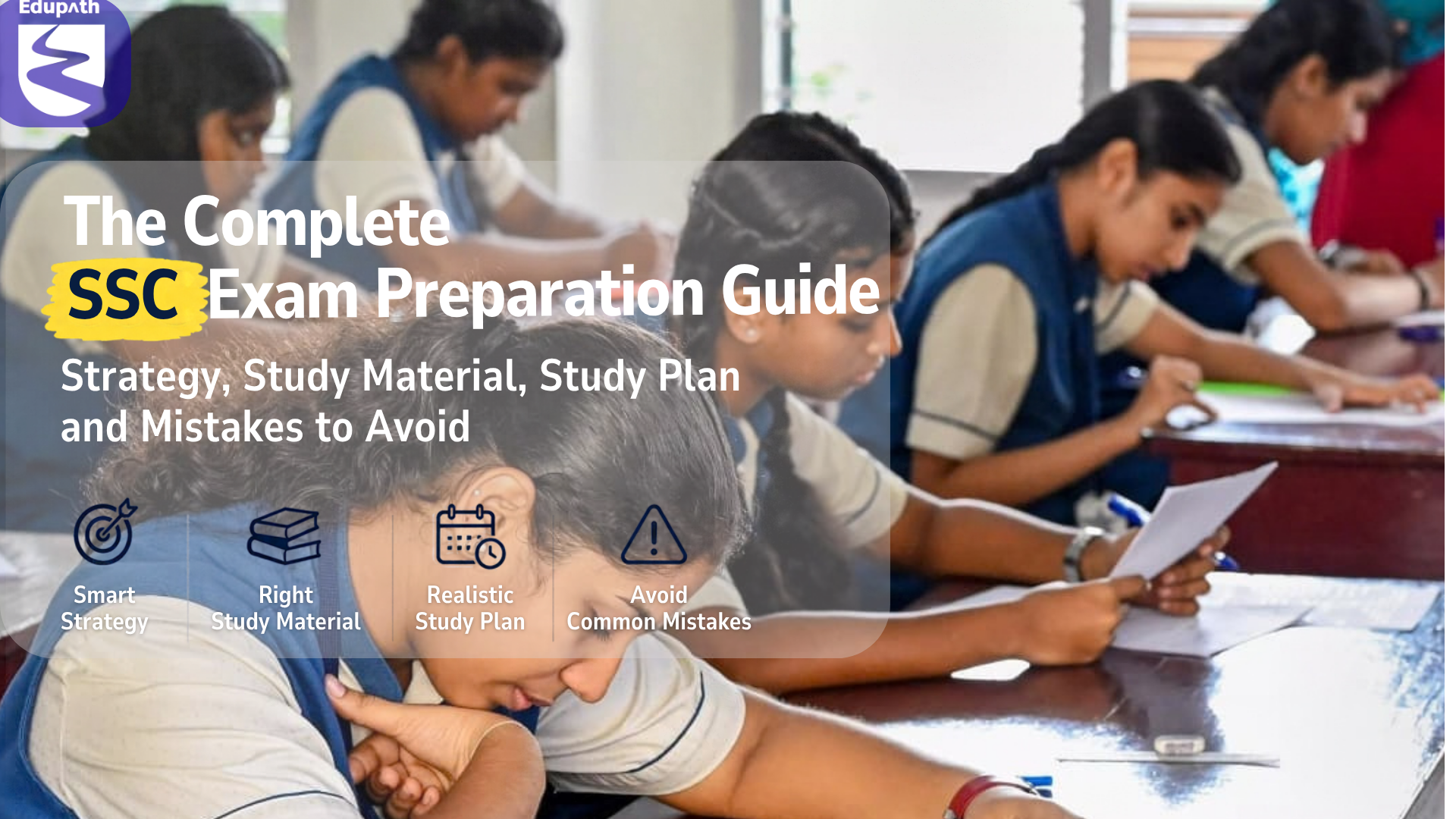
The Complete SSC Exam Preparation Guide: Strategy, Study Material, Study Plan and Mistakes to Avoid
Nobody Fails SSC Because of the Syllabus
If you spend enough time around SSC coaching centres, you start noticing a pattern. Aspirants who don't clear the exam rarely fail because the syllabus was too hard or the questions too unfamiliar. They fail because their preparation had a gap somewhere: a strategy that didn't match the exam, study material that was scattered instead of structured, a plan that existed only in their head, or a mistake repeated for months without anyone pointing it out.
This guide is an attempt to close those gaps in one place. Not motivational language, not a generic checklist, but an honest look at what a complete SSC preparation actually requires: the right strategy, the right material, a plan you can realistically follow, and a clear list of the mistakes worth avoiding from day one.
Step One: Understand the Exam Before You Understand the Syllabus
Most aspirants start by opening a syllabus PDF. A better first step is understanding how the exam itself is structured, because that shapes everything else.
Take SSC CGL as an example. It runs across multiple tiers:
- Tier-I is a qualifying, computer-based test covering General Intelligence & Reasoning, General Awareness, Quantitative Aptitude and English Comprehension, usually with sectional timing and a negative mark of 0.5 for every wrong answer.
- Tier-II is where the real merit decision happens, with a heavier quantitative paper, English, and post-specific components like statistics or computer knowledge.
SSC CHSL follows a similar Tier-I structure but stays closer to a 10th-12th level of difficulty, with a descriptive paper in Tier II instead of advanced maths.
Why does this matter before you even open a book? Because a Tier-I qualifying exam with sectional timing rewards a very different preparation style than a merit-deciding paper with no time restriction. Knowing this early changes how you allocate your months, not just your days.
Building a Strategy That Matches How the Exam Actually Works
A strategy isn't a motivational plan. It's a set of decisions about where your limited time goes, based on how the exam scores you.
Weight your effort by marks, not by comfort.
Quantitative Aptitude usually carries significant weight across Tier-I and dominates CGL's Tier-II. If you're spending more hours on your favourite section than on the one carrying the most marks, that's a strategy problem, not a discipline problem.
Decide your section order in advance, and test it.
Since most SSC Tier-I exams don't force a fixed section order, aspirants who start with their strongest section often build early confidence that carries through the rest of the paper. This isn't universal, though. The only way to know what works for you is trying different orders in mock tests, not guessing on exam day.
Plan around negative marking, deliberately.
A 0.25 or 0.5 mark penalty sounds small until you do the maths: four wrong answers can cancel out one correct one. Your strategy needs a clear, practiced rule for when to attempt an uncertain question and when to leave it, not a decision made in the pressure of the actual exam.
Treat GA and English differently from quant and reasoning.
Quant and reasoning respond to intense, timed practice. General Awareness and English vocabulary respond to slow, daily exposure over months. A strategy that treats all four subjects the same way usually shortchanges the two that need patience.
Choosing Study Material Without Drowning in It
One of the quieter reasons aspirants struggle isn't a lack of material, it's too much of it. Free content, paid courses, YouTube channels, PDFs shared in Telegram groups: it's genuinely possible to spend more time collecting resources than using any of them properly.
What good SSC study material actually looks like:
• Concept notes that explain reasoning, not just formulas. You want to understand why a shortcut works, not just memorise it, because SSC questions often twist familiar formats slightly.
• Topic-wise practice sets, graded from easy to exam-level. Jumping straight to hard questions before the basics are solid usually just builds frustration.
• Previous-year-style questions. These teach you how SSC actually frames questions, which is often different from generic practice material.
• Full-length mocks matching the current pattern, including sectional timing where it applies.
• A short, revisable current-affairs source, updated regularly rather than a single large GK book you read once.
The rule that matters more than which resource you pick: choose one reliable source per subject, and go deep instead of wide. Finishing one well-structured course properly beats sampling five and completing none of them.
A Study Plan You Can Actually Follow
A plan only works if it survives contact with a real week, including the weeks where things go wrong. Here's a template built around that idea, using a five-month runway as an example; stretch or compress it based on your own timeline.
Phase 1 (roughly the first month): Foundation Cover core concepts across all four subjects without chasing speed yet. Start a small daily reading habit and a short daily current-affairs routine. The goal here is understanding, not performance.
Phase 2 (month two): Build strength Shift to topic-wise practice under time limits. Identify your two or three weakest areas honestly, not the ones that feel weak, but the ones your practice scores actually show are weak.
Phase 3 (month three): Full coverage Finish any remaining syllabus topics. Start weekly sectional tests. This is also the point to start an error log, if you haven't already, tracking not just what you got wrong but why.
Phase 4 (month four): Mock-heavy phase Move to two or three full-length mocks a week. Spend as long analysing each mock as you spent taking it. This phase decides most of your final improvement, more than any other.
Phase 5 (final month): Consolidation Revise formulas, your error log, and weak topics. Take lighter mocks in the last week. Protect sleep over squeezing in new topics you haven't touched before.
A plan like this only works with one more ingredient: a fixed daily or weekly revision slot. Without it, general awareness and formulas fade almost as fast as you learn them.
The Mistakes That Quietly Undo Good Preparation
Some mistakes are obvious. These are the ones that tend to hide inside otherwise sincere preparation, which is exactly what makes them costly.
- Taking mocks without properly reviewing them. A mock test taken and immediately set aside teaches you almost nothing. The review, going through every wrong answer and understanding why it was wrong, is where most of the actual learning happens.
- Practicing without time limits. If the real exam has sectional timing, practicing without it builds a false sense of readiness that collapses the moment the clock starts running for real.
- Postponing General Awareness to the last month. GA is the section most damaged by cramming. A small daily habit over months beats a frantic reading spree in the final weeks, almost every time.
- Guessing randomly under negative marking. Random guessing, done consistently, tends to cost marks rather than add them once you factor in the penalty. Educated elimination is different from a blind guess, and knowing which one you're doing matters.
- Collecting material instead of finishing it. A folder full of unopened PDFs and unfinished courses feels like progress. It isn't. One resource per subject, completed properly, beats five sampled halfway.
- Skipping the "hard" topics entirely. Geometry, trigonometry, and certain reasoning types get avoided because they feel harder to learn. They still show up on the paper, often enough to matter, and skipping them caps your score in a way that's easy to underestimate.
- Not tracking progress with real numbers. Preparation without a score log turns into a feeling rather than a fact. "I think I'm improving" is a lot less reliable than a simple record of mock scores and sectional accuracy over weeks.
- Ignoring the official notification and calendar. Exam dates and patterns shift, sometimes more than aspirants expect. Planning your months around outdated information, rather than the current official calendar and syllabus, can leave your preparation misaligned with the actual exam.
Bringing It Together
A complete SSC preparation isn't one big decision, it's a series of smaller, correct ones repeated consistently: understanding the exam structure before diving into the syllabus, weighting your effort by marks rather than comfort, choosing a small set of reliable study material and finishing
it, following a plan that has a phase for foundation, practice, and consolidation, and avoiding the handful of mistakes that quietly erode months of honest effort.
None of this requires exceptional talent. It requires structure, and structure is something you can build deliberately, even if it isn't there yet.
How EduPath Supports This Kind of Preparation
EduPath's SSC program is built around the exact structure described in this guide, rather than around volume of content.
• Structured, topic-wise study material across Reasoning, Quantitative Aptitude, English and General Awareness
• A phased study plan, moving from foundation to practice to mock-heavy revision.
• Regular mock tests with detailed, topic-wise feedback, not just a final score.
• Doubt-clearing support, so a stuck concept doesn't sit unresolved for days.
• Progress tracking, so improvement is visible in numbers, not just a feeling.
We won't promise a guaranteed selection, since a meaningful part of the outcome always depends on the aspirant's own consistency. What we can offer is a program that removes the common gaps described above: scattered material, an unclear plan, and mistakes nobody points out until it's too late to fix them.
Frequently Asked Questions
How long does it realistically take to prepare for SSC exams?
Most aspirants need three to five months of steady, structured preparation, though this varies with your starting level and daily study hours.
Should I focus on Tier-I or Tier-II first?
Tier-I first, since it's qualifying, but don't ignore Tier-II preparation entirely, especially for CGL, where Tier-II carries significantly more weight in the final merit.
How many mock tests are enough?
Around 15 to 20 mocks, properly analysed, usually help more than 50 taken without review. Quality of review matters more than sheer quantity.
Is coaching necessary, or can self-study work?
Both can work. Coaching tends to help most with structure, mock quality and doubt resolution; disciplined self-study with good material can achieve the same result with more personal effort.
What's the single most common reason aspirants don't clear SSC exams despite studying hard?
Not reviewing mock tests properly, and postponing General Awareness. Both are fixable with a small change in routine, not a change in how many hours you study.
Final Thought
SSC exams reward preparation that's structured, not just sincere. If your current preparation feels effortful but directionless, the fix is rarely "study more." It's usually a clearer strategy, better chosen material, a plan with real phases, and an honest look at which of the mistakes above might be quietly present in your own routine. If you'd like help building this kind of structured preparation, EduPath's SSC program is designed around exactly that.
CONTACT : +91 97463 49575
CONTACT US