Marine Engineering vs Nautical Science vs DNS: Which Should You Choose After Plus Two?
By the EduPath Maritime Faculty, Kaloor, Ernakulam
Every year, around the time Plus Two results come out, the same scene plays out in our Kaloor office. A student walks in with a parent, both of them clear about one thing: the sea is the goal. And both of them confused about everything else. "Which course should he take? Somebody said engineering is better. Somebody else said DNS is the fastest way to get on a ship."
They are not confused because they are careless. They are confused because Marine Engineering, B.Sc Nautical Science and DNS sound like three versions of the same thing, and most of what is written online either sells a particular college or repeats brochure language. This blog is our attempt at a straight answer, the kind we give across the table.
Short version: these are three different jobs on a ship, with three different daily lives, and picking the wrong one is a bigger mistake than picking the wrong college. Let us walk through it properly.
First, understand that a ship has two worlds
On any merchant ship there are two main departments, and the courses you are comparing map onto them directly.
The deck department runs the ship. Deck officers navigate, plan the voyage, keep watch on the bridge, handle cargo operations, deal with ports, authorities and inspections, and ultimately one of them becomes the Captain. Nautical Science and DNS both lead to this side.
The engine department keeps the ship alive. Engineers look after the main engine, generators, boilers, pumps, purifiers, cooling systems and everything mechanical and electrical that lets a 200-metre vessel move and function in the middle of an ocean. Marine Engineering leads to this side.
So the real question is not "which course is better". It is: do you see yourself on the bridge or in the engine room? Once you answer that honestly, you are halfway done, because the choice reduces to engineering versus the deck, and then, on the deck side, B.Sc versus DNS.
The three courses at a glance
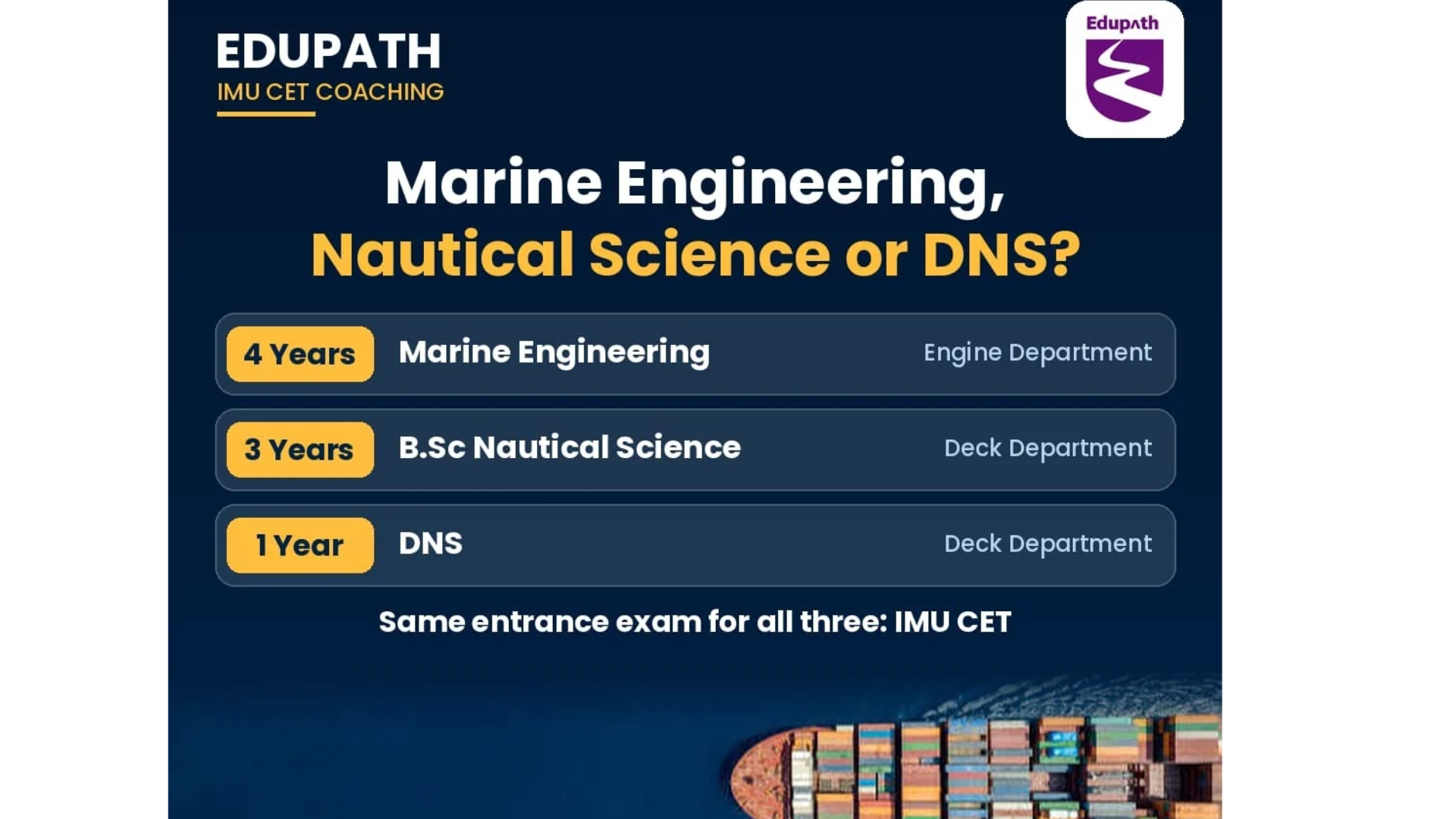
A note on that table. Durations, degree names and structure are as the Indian Maritime University and DG Shipping describe them, but admission rules get revised, so always confirm against the latest IMU notification before you apply.
One thing all three share: you cannot skip IMU CET
This surprises many families. Whether you are eyeing Marine Engineering, Nautical Science or DNS, admission to a DG Shipping approved institute, government or private, goes through your IMU CET rank. A private college cannot admit you on a donation or a management quota for these pre-sea courses. If a college tells you otherwise, walk away and verify with IMU.
The basic eligibility, as published in recent IMU notifications:
- Plus Two with Physics, Chemistry and Mathematics, with an average of at least 60 percent in PCM.
- At least 50 percent in English, in either Class 10 or Class 12.
- Minimum age of 17, with an upper age limit that differs by gender and category (for example, the general-category limit has been 25 for male candidates and 27 for female candidates, with relaxations for reserved categories).
- Medical fitness as laid down by DG Shipping, including eyesight and colour vision standards.
That last point deserves its own section, because it decides things before the exam even starts.
Check your eyes and health before you fall in love with a course
We have seen students prepare for a year and then get stopped at the medical stage. Do not let that be you.
Deck roles have stricter vision and colour perception requirements because you will be reading lights, buoys, signals and radar in all kinds of conditions. Engine roles are a little different in what they demand, but fitness for sea service still applies to both. Squint or any serious eye condition is a problem for the pre-sea courses. Hearing, general health and fitness matter too.
So before you decide, get a basic eye check done and read the current DG Shipping medical standards. If you wear glasses, find out where you stand on the vision norms for the specific course. It is far better to learn this in Plus Two than after paying a year of coaching fees. If anything is borderline, bring the report to us and we will tell you honestly what the options look like.
B.Tech Marine Engineering: the engine room route
This is the four-year degree for students who enjoy knowing why things work. You study thermodynamics, mechanics, electrical systems, marine engines, auxiliary machinery, ship construction, and the safety and environmental rules that govern what a ship can and cannot do.
What the work actually feels like. Engine rooms are hot, loud and busy. You will do watchkeeping, maintenance, fault-finding, and repairs, sometimes at odd hours. The work is hands-on and technical. When something breaks at sea, there is no workshop nearby and no one to call, so engineers develop a certain self-reliance that is hard to find in shore jobs.
Career ladder. You start as a trainee or junior engineer, then move up through Fourth, Third and Second Engineer to Chief Engineer, clearing the required competency exams and completing sea time at each stage.
Why students choose it. The degree is a full B.Tech, which gives you more options on land than the other two courses. If you leave the sea after some years, engineering knowledge travels well into ship management, power plants, ports, offshore work, marine surveying and technical superintendent roles.
Who should think twice. Students who dislike mathematics and physics will struggle here, because the course is genuinely technical. And if the idea of an engine room sounds unpleasant, that feeling does not go away after admission.
B.Sc Nautical Science: the bridge route, taken slowly
This is the three-year residential degree for the deck side. It covers navigation, seamanship, meteorology, cargo handling, ship stability, maritime law, collision regulations, communication and bridge management.
What the work actually feels like. Deck work mixes thinking with physical effort. You keep bridge watches, plan routes, monitor weather, supervise cargo operations, handle documentation and coordinate with ports. It is a job about decisions and responsibility. People skills matter more than students expect, because you will manage crews of different nationalities and deal with surveyors, agents and authorities.
Career ladder. From Deck Cadet you move to Third Officer, then Second Officer, Chief Officer and finally Master. Each step needs sea time and a competency exam, and the later steps are where many careers slow down, because the exams are tough and the number of senior positions is limited.
The money side. In most private colleges this course is self-financed, and the fees run into several lakhs across the programme. Hostel, uniform, books and other costs come on top. Ask any college for the full cost in writing, not just the tuition figure.
Who should think twice. Students who want a clear, predictable life. The deck career rewards patience and judgment, but it is not a nine-to-five.
DNS: the short route, and why it needs a cooler head
Diploma in Nautical Science is a one-year residential course leading to a B.Sc (Applied Nautical Science). It exists to produce deck officers faster than the three-year degree.
The attraction is obvious: one year instead of three, quicker entry to ships, lower upfront time commitment. This is why so many students ask us about it first.
Here is the part brochures tend to skip. DNS is closely tied to sponsorship. In practice, a large number of DNS seats are linked to shipping companies that select and sponsor candidates, which means your path involves clearing the CET and then being picked by a company. The course is shorter, but the selection is competitive and the interviews, medicals and company processes are real hurdles.
There are two ways to misjudge DNS. One is to treat it as an easy back door, which it is not. The other is to ignore it because it sounds too good, which would be a mistake for the right student: someone with strong marks, solid English, good communication and a clean medical record can do very well through the sponsorship route.
DNS is also open to some graduates in science and engineering who meet the criteria, so you may see it described as an option later in life as well. For this blog we are looking at it as a Plus Two choice.
Two practical warnings. First, sponsorship availability changes with the shipping market, so what was true last year may not hold this year. Second, "guaranteed placement" is a phrase to treat with suspicion unless you see it in writing from the company, not just the training institute.
Nautical Science or DNS: how to choose on the deck side
This is the question we get most often, so here it is plainly.
Choose DNS if your Plus Two marks are comfortably above the cut-off, your English and communication are strong, your eyesight and medical fitness are clean, and you are ready to compete for sponsorship. Prepare as if you have one shot and treat the sponsorship interview as seriously as the CET.
Choose B.Sc Nautical Science if you want a degree-first route with more breathing room, your rank may not be high enough for a sponsored seat, or your family can handle the cost and prefers a longer, more structured programme. The three years also give you time to grow before you go to sea, which suits younger students.
Neither is smarter than the other. They are different bets with different risks.
Engineering or deck: five questions to ask yourself
Sit with these honestly, ideally away from friends and relatives who all have opinions.
Do you enjoy taking things apart? If you are the person who opens the cycle, the mixer or the phone to see what is inside, engineering fits you.
Do you enjoy being the one who decides? If you like organising people, reading situations and taking responsibility, deck fits you better.
How do you feel about mathematics and physics? Both paths use them, but engineering uses them daily and deeply.
Can you handle months away from home? Contracts on ships commonly run for several months at a stretch, with long gaps from family, festivals and ordinary life. This is the same for all three courses.
What do you want if the sea does not work out? If you want the widest range of shore options later, a B.Tech gives you more flexibility than a B.Sc.
The part nobody advertises: life at sea
It is worth saying clearly, because it matters more than the course name.
Ship life means long separation from family, limited internet on many vessels, isolation, shift work and fatigue. It also means seeing ports across the world, earning well compared to many shore careers at the same age, and a level of responsibility you rarely get on land so early. People who thrive at sea tend to be calm, adaptable and reasonably independent. People who struggle are usually those who went in only for the salary.
If possible, talk to a working officer or engineer before deciding. One conversation with someone who has done six contracts will teach you more than ten brochures.
Money: a fair way to think about it
Seafarer salaries in India are good, and that is a big reason students apply. But the figures you see on social media are usually the senior-rank, tax-friendly highlights. Starting pay as a cadet is modest. Growth depends on clearing exams, getting sea time, the company you join and the shipping market.
A more useful comparison than "how much will I earn" is: what will it cost me to reach my first paid officer rank, and how long will it take? DNS tends to cost less in time. B.Sc and B.Tech cost more in both time and fees, but offer a degree that holds value on land. Ask every college for a full cost sheet and a realistic account of how their graduates actually get placed.
Careers that open if you leave the ship
Most seafarers do not stay at sea for an entire career. Common shore moves include port operations, ship management and fleet operations, marine surveying, maritime training, shipping and logistics companies, and technical or marine superintendent roles. Engineers often find the widest range of shore options, while deck officers move naturally into operations, port, pilotage and shipping management.
Mistakes we see every year
Choosing by college name. A famous name does not fix a wrong course. Match the department to your nature first, then compare colleges.
Skipping the medical check. Covered above, and worth repeating.
Starting CET preparation late. IMU CET is a 200-question computer-based test on English, aptitude, Physics, Chemistry and Mathematics at Class 12 level. A year of steady work beats three months of panic. Students who also need Class 12 marks to stay above the PCM cut-off should protect those marks, since eligibility depends on them.
Trusting agents who promise seats. If anyone promises admission outside the CET rank, they are wrong or dishonest. The rank decides.
Deciding because a relative or neighbour earns well at sea. You are choosing a lifestyle, not a salary slip.
So which one should you choose?
If you like machines and problem-solving, go for Marine Engineering. If you like leadership, navigation and decisions, and can afford the three years, take B.Sc Nautical Science. If your marks, English and health are strong and you can compete for sponsorship, DNS is the fastest respectable route to the bridge.
If you are still unsure, that is normal at seventeen. The honest test is simple: imagine a normal Tuesday ten years from now on each of the three paths, and notice which one you do not want to run away from.
Frequently Asked Questions
Is IMU CET compulsory for Marine Engineering, Nautical Science and DNS?
Yes. For these pre-sea courses in DG Shipping approved institutes, admission goes through the IMU CET rank.
What is the minimum percentage needed after Plus Two?
An average of at least 60 percent in Physics, Chemistry and Mathematics, and at least 50 percent in English in Class 10 or 12. Always confirm with the latest IMU notification, since conditions can be revised.
Can I join these courses with Commerce or Humanities in Plus Two?
No. Physics, Chemistry and Mathematics in Plus Two are needed for these courses.
Which course has better salary, Marine Engineering or Nautical Science?
Both pay well at senior ranks. Engineers and deck officers at comparable ranks are in a similar range, so choose by aptitude, not by salary rumours.
Is DNS better than B.Sc Nautical Science?
Not automatically. DNS is faster and relies on sponsorship. B.Sc is longer and more self-funded. The better one depends on your marks, health, finances and risk comfort.
Can I wear glasses and join the deck department?
Vision standards are set by DG Shipping and depend on the course and role. Check the current medical norms and get an eye test done early. Do not assume.
Can girls join these courses?
Yes. Women are eligible and are working in both deck and engine departments, although the number is still small. Check the latest IMU notification for course-specific details.
Can I switch from deck to engine, or the reverse, after joining?
Not easily. The two departments follow different training and certification paths, so decide carefully before admission.
When should I start preparing for IMU CET?
Ideally from Plus One, or at least a year before the exam. Students who start early find the Class 12 PCM syllabus much more manageable.
Is a sea career safe?
Shipping is regulated and safety standards have improved a great deal, but life at sea carries real risks and demands discipline. Training, certification and following procedures matter more than any brochure.
How EduPath helps
At EduPath, Kaloor, we coach students for the IMU CET and for sponsorship selection, with online and offline batches, hostel facilities for outstation students, experienced faculty and regular mock tests built on the actual IMU pattern. Our work does not stop at the syllabus. We sit with students and parents to talk through which course suits the student, check the basic eligibility and medical points early, and build a plan around the date of the next CET.
If you are in Plus One or Plus Two and thinking about the sea, come and talk to us before you finalise anything. A conversation costs nothing and often saves a year.
Phone: 9746349575
Join nowContact us