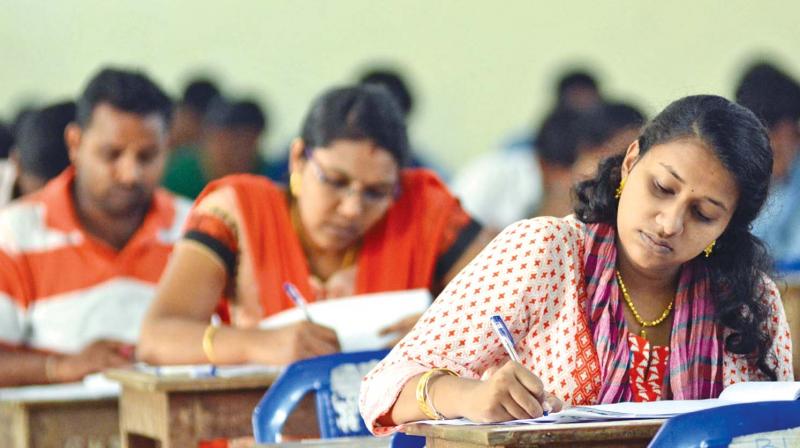
KLEE 2027 Exam Pattern, Syllabus and Negative Marking: Complete Section-Wise Guide
KLEE 2027 Exam Pattern and Syllabus: Know the Paper Before You Prepare
Preparing for a law entrance examination requires more than studying the syllabus. Candidates must understand the examination structure, marking scheme and time-management strategies before starting their preparation.
The KLEE 2027 exam pattern is an important starting point for students planning to pursue a 3-year or 5-year LLB programme in Kerala.
In this guide, EduPath explains the examination pattern, section-wise distribution, important syllabus topics, negative marking and practical preparation strategies to help aspirants organise their studies.
Important update: The details below use the official KLEE 2026 LLB examination pattern as a reference. The KLEE 2027 notification and prospectus must be checked for confirmation of the examination structure, syllabus and marking scheme.
KLEE Exam Pattern at a Glance
According to the CEE Kerala notifications for the 2026 admission cycle, the 3-year and 5-year LLB entrance examinations followed the pattern shown below.
These figures are based on the 2026 examination cycle and are not a guarantee of the KLEE 2027 pattern.
Candidates should refer to the official CEE Kerala website for the latest prospectus: https://cee.kerala.gov.in/
KLEE Section-Wise Question Distribution
The reported distribution for the 2026 LLB entrance examination was as follows.
What does this distribution mean for your preparation?
- Aptitude for Legal Studies carries the largest share, accounting for 35% of the questions in the 2026 reference pattern.
- General English accounts for 30% of the questions.
- Together, these two sections represent approximately 65% of the paper.
- General Knowledge and Current Affairs require consistent reading and revision.
- Arithmetic and Mental Ability can improve with regular practice of basic concepts and problem-solving techniques.
The section-wise distribution should be verified against the official KLEE 2027 prospectus before you finalise your study timetable.
KLEE 2027 Syllabus: Section-by-Section Guide
Understanding the KLEE 2027 syllabus helps you divide your preparation into manageable topics. The following topics are commonly associated with the four sections in preparation materials. They are a study guide, not a confirmed official 2027 syllabus.
1. General English
The General English section assesses reading comprehension, vocabulary and language skills.
Important topics to practise include:
- Reading comprehension
- Vocabulary and word usage
- Grammar and sentence correction
- Synonyms and antonyms
- Idioms and phrases
- Foreign words and expressions
- Sentence arrangement and paragraph sequencing
- Inference-based questions
Preparation tip: Read reliable English-language articles regularly, revise grammar rules and maintain a vocabulary notebook. Practise comprehension questions to improve your reading speed and accuracy.
2. General Knowledge and Current Affairs
This section tests awareness of important events and general knowledge.
Topics to revise include:
- National and international current affairs
- Sports and major sporting events
- International organisations and geopolitics
- Environmental developments and agreements
- Awards, honours and notable personalities
- Important legal and constitutional developments
Preparation tip: Follow current affairs throughout your preparation. Create monthly revision notes and regularly review major national developments, constitutional issues and important legal news.
3. Arithmetic and Mental Ability
This section evaluates numerical ability, logical thinking and problem-solving skills.
Topics commonly covered in preparation resources include:
- Averages, percentages, ratios and proportions
- Profit and loss
- Time and distance
- Time and work
- Simple and compound interest
- Basic algebra and mensuration
- Analogy and coding-decoding
- Blood relations
- Syllogisms and logical inferences
- Data interpretation
Preparation tip: Practise a small set of questions every day. Review incorrect answers to understand whether the difficulty came from a calculation error, a misunderstood concept or poor time management.
4. Aptitude for Legal Studies
Aptitude for Legal Studies is an important section in the reported KLEE LLB pattern.
Preparation topics may include:
- Basic legal awareness and legal reasoning
- Constitutional law and Indian polity
- Law of torts
- Law of crimes
- Law of contracts
- International law
- Intellectual property rights
- Assumptions, arguments and logical inferences
The precise scope of the section should be confirmed from the official syllabus when it becomes available.
Preparation tip: Practise applying a stated legal principle to a given situation. Focus on understanding the facts, identifying the relevant principle and selecting the option that follows logically.
Students do not need to assume that they must already know advanced law to begin preparing. Start with basic concepts and use practice questions to develop legal reasoning skills.
KLEE Negative Marking: How Does It Work?
Under the reported KLEE 2026 LLB marking scheme:
- Correct answer: +3 marks
- Incorrect answer: −1 mark
- Unanswered question: 0 marks
This means an incorrect answer reduces your score. Accuracy and thoughtful decision-making are therefore important.
Important: Confirm the negative-marking rules in the official KLEE 2027 prospectus before applying this strategy to the examination.
Understanding the Mathematics of Guessing
Assuming a question has four equally likely options and the +3/−1 marking scheme remains unchanged, the expected score from guessing can be calculated as follows.
1. Guessing without eliminating any option
There is a one-in-four chance of gaining 3 marks and a three-in-four chance of losing 1 mark.
Expected score:
[
\left(\frac{1}{4}\times3\right)
-\left(\frac{3}{4}\times1\right)=0
]
\left(\frac{1}{4}\times3\right)
-\left(\frac{3}{4}\times1\right)=0
]
The expected score is zero under these assumptions.
2. Guessing after eliminating one option
If three options remain and each is equally likely to be correct:
[
\left(\frac{1}{3}\times3\right)
-\left(\frac{2}{3}\times1\right)
=\frac{1}{3}
]
\left(\frac{1}{3}\times3\right)
-\left(\frac{2}{3}\times1\right)
=\frac{1}{3}
]
The expected score is approximately +0.33 marks.
3. Guessing after eliminating two options
If two options remain and each is equally likely to be correct:
[
\left(\frac{1}{2}\times3\right)
-\left(\frac{1}{2}\times1\right)=1
]
\left(\frac{1}{2}\times3\right)
-\left(\frac{1}{2}\times1\right)=1
]
The expected score is +1 mark.
These calculations assume that the remaining options are equally likely to be correct. They are mathematical illustrations, not a guarantee of a particular result.
Practical takeaway: Avoid choosing answers randomly when you have no basis for a decision. Eliminate options where possible, assess your confidence and follow the marking rules stated in the official examination instructions.
The Best Way to Attempt the KLEE Paper
The 2026 reference pattern provided 120 minutes for 120 questions. That works out to an average of one minute per question.
A flexible attempt strategy can help you manage the examination more effectively.
1. Begin with a Comfortable Section
Start with a section in which you can answer questions accurately and efficiently. Depending on your strengths, this might be English, Arithmetic or another section.
2. Answer Questions You Know First
During your first pass, answer questions you understand confidently. If a question takes too long, mark it for review if the examination interface permits and move on.
3. Allocate Time for Legal Aptitude
The Legal Studies section accounted for the largest number of questions in the 2026 reference pattern. Practise applying legal principles efficiently so that lengthy questions do not consume all your available time.
4. Return to Difficult Questions
Use a second pass to revisit questions you skipped. Eliminate clearly incorrect options and make a decision based on your understanding and the official marking scheme.
5. Reserve Time for Review
If possible, keep the final 5–10 minutes for reviewing marked questions and checking for unanswered questions you intended to attempt.
6. Prioritise Accuracy
A high number of attempts does not automatically mean a high score. Review your mock-test results to identify careless mistakes and topics that need additional practice.
Your ideal approach should be developed through practice tests rather than adopted without adjustment.
A Simple KLEE Preparation Timeline
Use this sample timeline to organise your preparation. Adjust it according to the actual examination date, your starting level and the official syllabus.
Months 1–3: Build the fundamentals
- Review English grammar and comprehension.
- Strengthen basic arithmetic and mental ability.
- Begin learning introductory legal concepts.
- Develop a regular current-affairs reading habit.
Months 4–6: Practise topic-wise questions
- Complete practice exercises for each section.
- Create revision notes for current affairs.
- Identify weaker topics and revisit them.
- Begin taking short, timed tests.
Months 7–9: Improve exam readiness
- Attempt full-length mock tests using a computer-based format where possible.
- Analyse incorrect answers.
- Track time management and accuracy.
- Revise difficult topics systematically.
Final month: Revise and consolidate
- Review important concepts and notes.
- Take timed mock tests at a manageable frequency.
- Practise questions from previously studied topics.
- Avoid making major changes to your study plan at the last moment.
This is a flexible preparation framework, not an official CEE Kerala timetable.
Common Mistakes KLEE Aspirants Should Avoid
Students preparing for the Kerala Law Entrance Examination can improve their preparation by avoiding these common mistakes:
- Ignoring Legal Aptitude because they believe prior legal education is necessary.
- Spending too much time on current affairs while neglecting English and other sections.
- Guessing carelessly without considering negative marking.
- Practising only on paper without becoming familiar with computer-based tests.
- Delaying mock tests until the final stage of preparation.
- Memorising answers without understanding the concepts.
- Following unverified examination patterns from older articles.
A balanced study plan, regular practice and careful review can make preparation more organised.
Frequently Asked Questions About KLEE 2027
How many questions are there in KLEE 2027?
The 2026 LLB examination had 120 objective-type questions for 360 marks, with a duration of two hours. The KLEE 2027 question count and total marks must be confirmed in the official prospectus.
Is there negative marking in KLEE 2027?
The 2026 LLB marking scheme deducted one mark for every incorrect answer and awarded three marks for each correct answer. Check the 2027 prospectus to confirm whether the same system applies.
Is the syllabus the same for 3-year and 5-year LLB?
The 2026 LLB notifications listed the same four broad subject areas for both programmes. Candidates should consult the respective 2027 notifications for the final syllabus and examination details.
Which section has the highest weightage?
In the reported 2026 section-wise distribution, Aptitude for Legal Studies had the highest weightage, followed by General English. The 2027 distribution has not been confirmed.
Do I need to study law before preparing for KLEE?
You can begin by learning basic legal concepts and practising legal reasoning. Advanced legal knowledge should not be assumed to be a prerequisite for starting your preparation. Follow the syllabus and instructions published by CEE Kerala.
Is there a sectional time limit in KLEE?
The 2026 examination information specified a total duration of two hours. Check the official 2027 instructions to confirm how time is managed across sections and whether any interface restrictions apply.
Plan Your KLEE 2027 Preparation with EduPath
Preparing for a law entrance examination becomes more manageable when you have a clear timetable, regular practice and a way to review your progress.
EduPath Solutions can help students understand their preparation options and organise a study plan around their academic commitments.
EduPath Solutions
Sree Muruga Building, Kaloor, Ernakulam – 682017
Phone: 9746349575
CONTACT USSree Muruga Building, Kaloor, Ernakulam – 682017
Phone: 9746349575
JOIN NOW
Contact EduPath for guidance on planning your entrance-exam preparation.
Disclaimer
This article is intended for general educational guidance and uses information from the KLEE 2026 LLB admission cycle as a reference. The KLEE 2027 examination pattern, syllabus, section-wise distribution, marking scheme and other admission details may change. Topic lists and preparation suggestions in this article should not be treated as a substitute for the official syllabus. EduPath Solutions is not affiliated with CEE Kerala or any government authority. Candidates should verify all examination details through the official website, https://cee.kerala.gov.in/, before making application or preparation decisions.