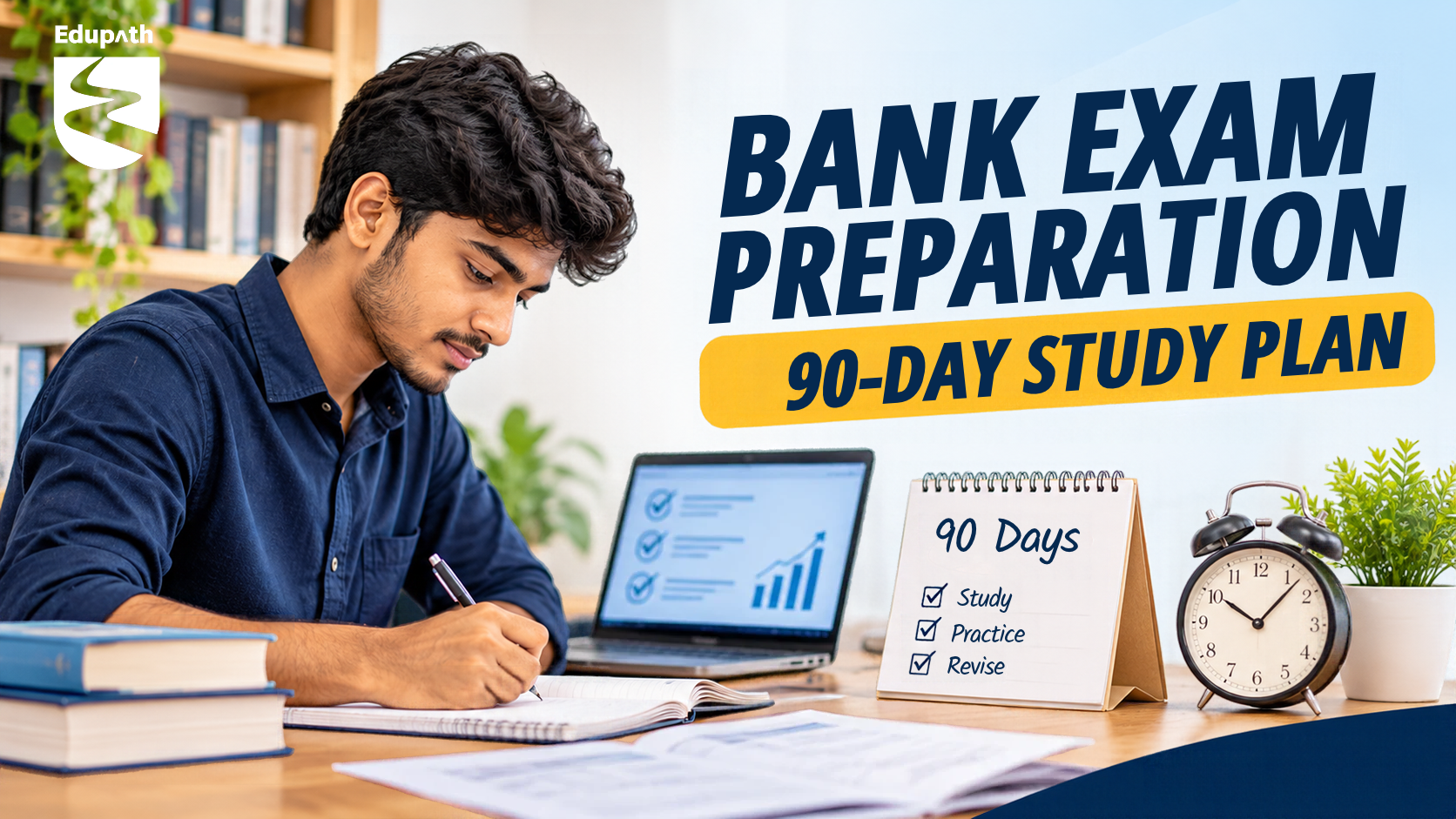
How to Prepare for Bank Exams in 3 Months: A Practical 90-Day Study Plan
Preparing for a bank exam in just three months may seem challenging, especially if you are starting from the basics. However, with a proper study timetable, consistent practice and the right preparation strategy, you can make significant progress in 90 days.
Banking examinations such as IBPS PO, IBPS Clerk, SBI PO, SBI Clerk and IBPS RRB attract thousands of candidates every year. These exams generally test candidates in areas such as English Language, Quantitative Aptitude, Reasoning Ability and General or Banking Awareness, depending on the examination stage.
Instead of studying randomly or collecting too many study materials, candidates should follow a structured bank exam preparation plan.
In this guide, we will explore a practical 90-day study plan, daily timetable, subject-wise preparation strategies, mock test techniques and common mistakes to avoid.
Can You Prepare for Bank Exams in 3 Months?
Yes, three months can be a useful preparation period, particularly if you already have a basic understanding of mathematics, English and reasoning.
However, your progress will depend on your current preparation level, available study time and consistency.
A successful bank exam preparation strategy should focus on three important areas:
- Understanding the syllabus and examination pattern.
- Improving speed and accuracy through regular practice.
- Identifying weak areas through mock tests and revision.
Remember that completing the syllabus alone is not enough. You must also learn how to solve questions accurately within the examination time.
Before Starting Your 90-Day Bank Exam Preparation
Before beginning your preparation, take a few important steps.
1. Choose your target examination
Decide whether you are preparing for IBPS PO, IBPS Clerk, SBI PO, SBI Clerk or RRB examinations. Although several subjects overlap, their examination patterns and selection processes may differ.
2. Understand the syllabus
Understand the topics covered in Quantitative Aptitude, Reasoning Ability, English Language and General Awareness. Check the latest notification for your chosen examination.
3. Take an initial mock test
Attempt one diagnostic mock test before starting your preparation. Your initial score will help you understand your strengths and weaknesses.
4. Prepare a realistic timetable
Choose a daily study schedule that you can follow consistently. Avoid creating an unrealistic timetable that becomes difficult to maintain.
90-Day Study Plan for Bank Exams
The following bank exam preparation plan divides 90 days into three phases. Each phase has a specific objective.
Phase 1: Days 1–30 – Build Your Fundamentals
The first month should focus on understanding basic concepts and developing a strong foundation.
Along with these subjects, start reading a newspaper daily and maintain notes on important current affairs.
At the end of the first month, attempt sectional tests to evaluate your understanding.
Phase 2: Days 31–60 – Improve Speed and Accuracy
The second month should focus on solving questions within a limited time.
Your main objectives should be:
- Practising quantitative aptitude questions regularly.
- Solving different types of reasoning puzzles.
- Improving English reading and comprehension skills.
- Starting sectional mock tests.
- Learning basic banking and financial awareness.
- Revising topics covered during the first month.
Weekly preparation targets
Do not become discouraged if your mock test scores are not improving immediately. Analyse your mistakes and work on the topics where you need more practice.
Phase 3: Days 61–90 – Mock Tests and Final Revision
The final month is extremely important because it helps you develop examination confidence and time management skills.
Focus on:
- Attempting regular full-length mock tests.
- Practising previous-year question papers.
- Revising important formulas and shortcuts.
- Improving accuracy in all sections.
- Revising current affairs and banking awareness.
- Spending additional time on weaker topics.
During the last few days, avoid starting completely new topics. Concentrate on revision, examination instructions and maintaining a consistent routine.
Daily Study Timetable for Bank Exam Aspirants
A proper daily timetable helps you manage all subjects without neglecting any important area.
Timetable for Full-Time Aspirants
Total: Approximately 7 hours
Timetable for College Students and Working Aspirants
Total: Approximately 3 hours
On weekends, allocate additional time for full-length mock tests and detailed performance analysis.
Subject-Wise Bank Exam Preparation Strategy
1. Quantitative Aptitude
Quantitative Aptitude is an important section in most banking examinations. Candidates should develop strong calculation skills and understand basic mathematical concepts.
Important topics include:
- Simplification and approximation
- Number series
- Percentage
- Ratio and proportion
- Average
- Profit and loss
- Simple and compound interest
- Time and work
- Speed, time and distance
- Data interpretation
- Quadratic equations
Preparation tips:
Practise calculations daily and learn useful mathematical shortcuts. Start with basic concepts before moving towards difficult questions.
Maintain a separate notebook for formulas and frequently repeated question types.
2. Reasoning Ability
Reasoning tests your logical thinking and problem-solving ability.
Important topics include:
- Seating arrangements
- Puzzles
- Syllogism
- Inequalities
- Coding-decoding
- Direction sense
- Blood relations
- Alphanumeric series
Preparation tips:
Begin with simpler reasoning questions and gradually practise more complex puzzles. Draw diagrams whenever necessary and use a timer to improve your solving speed.
3. English Language
English is an important subject in banking examinations. Candidates who find English difficult should give it regular attention instead of postponing preparation.
Important topics include:
- Reading comprehension
- Error spotting
- Cloze test
- Para jumbles
- Fill in the blanks
- Vocabulary
- Grammar
- Sentence improvement
Preparation tips:
Read English newspapers and articles regularly. Learn new vocabulary, revise grammar rules and practise at least one reading comprehension passage regularly.
Candidates from Malayalam-medium backgrounds can improve their English through consistent reading, vocabulary practice and grammar exercises.
4. General and Banking Awareness
General Awareness and Banking Awareness are particularly important for Mains examinations.
Focus on:
- Current affairs
- Banking terminology
- RBI and its functions
- Indian financial system
- Important government schemes
- Economic developments
- Banking-related news
Preparation tips:
Maintain monthly current affairs notes and revise them regularly. Focus on understanding important banking concepts rather than memorising information without context.
How to Use Mock Tests Effectively
Mock tests are one of the most useful tools in bank exam preparation. They help candidates understand examination difficulty, improve time management and identify weak areas.
However, simply attempting mock tests is not enough.
Follow these steps after every mock test:
- Review every incorrect answer.
- Identify questions that took too much time.
- Understand whether the mistake happened because of a weak concept or careless calculation.
- Practise similar questions.
- Record your mistakes in a separate notebook.
- Revisit your error log during weekly revision.
Try to build a consistent mock test routine. Around 25–30 full-length mocks over 90 days can be a useful target for candidates who have reached the appropriate practice stage, alongside sectional tests.
The quality of your analysis is more important than the number of tests you complete.
Common Mistakes to Avoid During Bank Exam Preparation
Many candidates spend months preparing but fail to follow an effective strategy. Avoid these common mistakes:
1. Collecting too many study materials: Choose reliable books, notes and practice resources instead of switching between multiple sources.
2. Ignoring English: Give equal attention to English, Quantitative Aptitude and Reasoning.
3. Avoiding mock tests: Begin with diagnostic and sectional tests, then gradually increase full-length mock practice.
4. Not revising regularly: Set aside time every week to revise previously studied topics.
5. Focusing only on strong subjects: Give additional attention to topics where you frequently make mistakes.
6. Ignoring current affairs: Build a daily habit of reading and revising important news.
7. Following unrealistic timetables: Consistency is more valuable than studying for long hours occasionally.
Frequently Asked Questions About Bank Exam Preparation
Can I crack a bank exam in 3 months?
Three months can provide a useful preparation window, particularly for candidates with a good foundation. However, success depends on the examination, competition, preparation level and individual performance.
How many hours should I study daily for bank exams?
Full-time aspirants can plan around 6–7 hours of focused study, while college students and working candidates can build a routine around 2.5–3.5 hours on weekdays and longer weekend sessions.
Which subject should I study first?
Start with the subject in which you have the weakest foundation. However, make sure that you practise all major subjects regularly.
Are mock tests important for bank exams?
Yes. Mock tests help improve time management, question selection, accuracy and familiarity with the examination environment.
Can beginners prepare for bank exams?
Yes. Beginners can start with basic concepts, gradually increase question difficulty and follow a structured study plan.
Is coaching necessary for bank exam preparation?
Coaching is not compulsory. However, structured classes, regular practice sessions, doubt-clearing support and mock test guidance can help candidates maintain a disciplined preparation routine.
Start Your Bank Exam Preparation with EduPath Solutions
Preparing for competitive banking examinations requires the right direction, consistent practice and a clear understanding of the syllabus.
At EduPath Solutions, Kaloor, Ernakulam, we encourage aspirants to follow a structured learning approach and develop the skills required for competitive examinations.
Whether you are beginning your bank exam preparation or improving your existing knowledge, having a clear study plan can make your preparation more organised.
Take the first step towards your banking career today.
Contact EduPath SolutionsJoin now
Final Note: Examination patterns, eligibility requirements, vacancies and dates may change between recruitment cycles. Always refer to the latest official notifications published by IBPS and SBI before applying.